

The Long-Sleeved Merino Wool Polo Shirt: A Wardrobe Essential
Not every wardrobe essential announces itself. The long-sleeved polo shirt is one of the quiet ones: casual enough for the football, smart enough for a good restaurant, and never quite the centre of attention either way. Chris Modoo talks through why he virtually lives in his, and what separates a merino wool polo from the cotton pique version sitting in most drawers.
Enter our prize draw for four style guides and £500 to spend
Shop the Video
 Navy Extra-Fine Merino Wool Polo Shirt
£260
Navy Extra-Fine Merino Wool Polo Shirt
£260
 Umber Extra-Fine Merino Wool Polo Shirt
£260
Umber Extra-Fine Merino Wool Polo Shirt
£260
 Dark-Grey Wool Flannel Jacket
£1,445
Dark-Grey Wool Flannel Jacket
£1,445
 Bonfire Celebrating Midsummer Night Pocket Square
£90
Bonfire Celebrating Midsummer Night Pocket Square
£90
 Dark-Brown Hopsack Wool Blend Jacket
£1,445
Dark-Brown Hopsack Wool Blend Jacket
£1,445
 Shipwreck on the Coast of Norway Pocket Square
£90
Shipwreck on the Coast of Norway Pocket Square
£90
 Navy-Blue Check Wool-Linen Blend Jacket
£1,445
Navy-Blue Check Wool-Linen Blend Jacket
£1,445
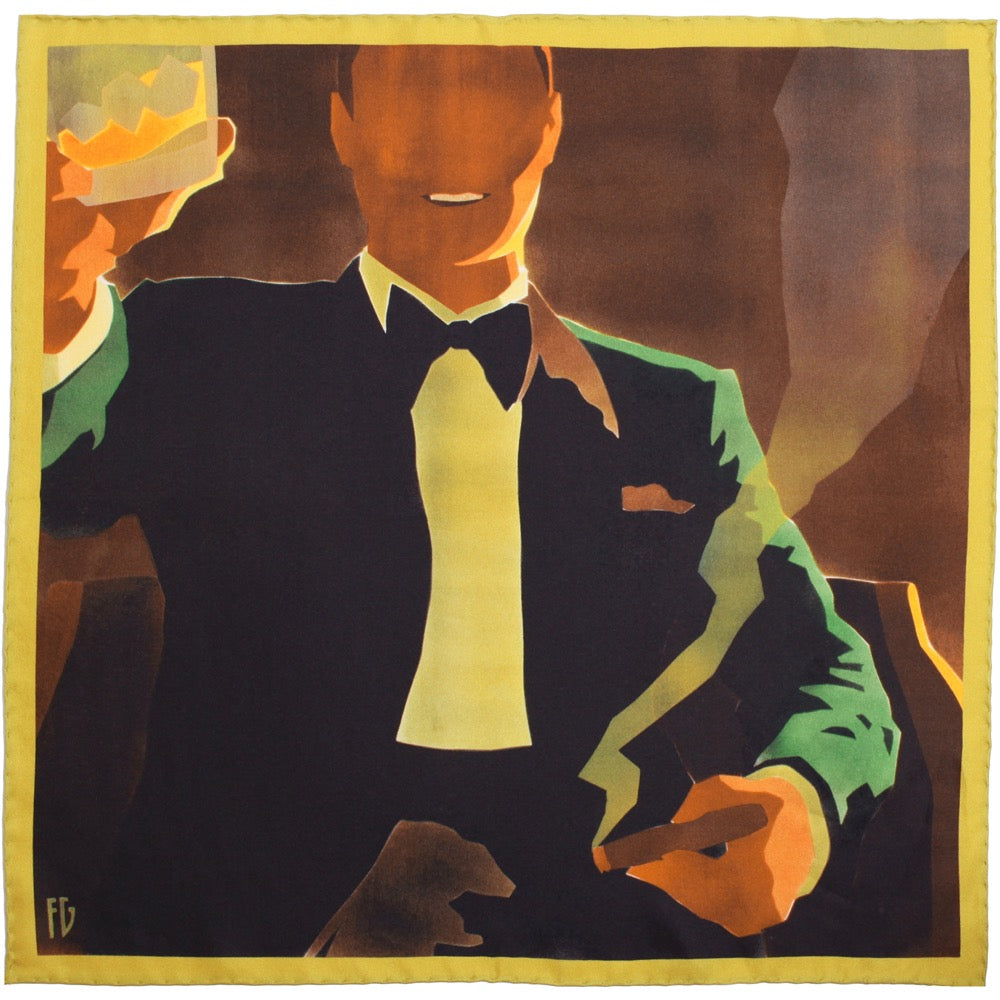 'Dernier Verre' Pocket Square
£90
'Dernier Verre' Pocket Square
£90
 Light-Grey Hopsack Wool Blend Jacket
£1,445
Light-Grey Hopsack Wool Blend Jacket
£1,445
 Grey & Bronze Geometric Bandana
£155
Grey & Bronze Geometric Bandana
£155
For more styling tutorials, subscribe to our channel
Subscribe to Our ChannelThe sweet spot
Why the Long-Sleeved Polo Shirt Earns Its Place in a Tailored Wardrobe
A wardrobe essential usually gets there by solving a problem nothing else quite solves. The long-sleeved polo shirt solves the problem of the day that changes its mind. You start at a football match with friends, move on to a bar, and end up at a restaurant that wants at least a little effort. A shirt and tie would be too much for the first stop. A t-shirt would be too little for the last. The polo shirt sits between the two, and it stays there without looking like a compromise.
What it offers is neutrality. Worn on its own it reads as smart-casual without trying. Worn under a jacket it reads as considered rather than incidental. That range is the entire case for owning one, and it explains why it survives seasons of trend cycles that cotton t-shirts and heavier knitwear do not: it is rarely the wrong choice, even when it is not obviously the most exciting one.
The catch is that not every polo shirt earns that versatility. A high-street cotton pique polo does a fine job at the beach or on the golf course, and there is nothing wrong with owning one for exactly those occasions. But ask it to sit under a jacket, or to carry a room on its own, and it starts to show its limits: a soft collar that folds flat within the hour, a fit built for movement rather than shape, a fabric that reads as leisurewear the moment you put it on. If a polo shirt is going to do more work in your wardrobe than a beach day, the fabric it is made from needs to do more work too.
The fabric
What Makes a Merino Wool Polo Shirt Different From Cotton Pique
Wool is not the first fabric most people associate with a polo shirt, and that is precisely the opening it exploits. Extra-fine merino wool, spun into a fine-gauge knit, produces a very different garment to the cotton pique version: closer to the weight and drape of a good dress shirt than to a sports top, with a collar that holds its shape rather than folding by lunchtime.
Several things separate a well-made merino wool polo from an ordinary one, and most of them are invisible until you know to look for them.
Micron measures the width of the raw wool fibre, graded as soon as the fleece is shorn. A count around 19.5 is not the super-fine territory reserved for the finest suiting cloths, but it is far removed from the coarse wool used in heavy overcoating. It sits closer to the quality found in good travel cloths, tweeds and lambswool jacketings: fine enough to sit comfortably against the skin, robust enough to survive being worn rather than admired.
The fibre is then top-dyed, meaning the colour is applied early in the process rather than after the yarn or finished garment is complete. Dyeing earlier generally produces a richer, more resistant colour, which is most of the reason a well-made wool polo shirt still looks the way it did on day one long after a cheaper garment has faded. From there, the fibre is spun into a two-fold yarn and knitted at a 30-gauge, a fine enough construction that the finished fabric almost reads as woven rather than knitted. The combination of fine micron, two-fold construction and tight gauge is what gives the shirt real softness against the skin without ever feeling precious to wear.
It is worth saying plainly: most designer knitwear will not tell you any of this. Brands selling wool and cashmere jumpers at a premium rarely disclose the micron count or whether the yarn has been top-dyed, because most customers never ask. The fact that a garment's construction can be stated this specifically is itself a signal of the quality behind it.
Dressing it up
How to Wear a Polo Shirt With a Jacket, and Even a Suit
The polo shirt's most surprising role is under tailoring, and it works better than most people expect. A navy polo shirt under a charcoal flannel jacket and trousers is a properly elegant combination: sophisticated rather than casual, closer in spirit to a jazz club than a golf course. The quality of the polo shirt is what makes or breaks the look. A soft, loose-fitting cotton pique will not hold its own against tailoring. A fine-gauge merino wool polo, with a properly fashioned collar and mother-of-pearl buttons rather than plastic ones, reads as finished rather than thrown together.
The key to putting a polo shirt with tailoring is choosing single-breasted jackets with notch lapels, and sizing the polo close to the body rather than tight. Merino wool has a natural stretch that makes this comfortable rather than restrictive.
A slimmer-cut jacket suits this pairing better than a fuller one, and flat-front, fairly slim trousers keep the proportions clean underneath. Black penny loafers finish it well, and the whole combination has an easy confidence that a shirt and tie cannot quite match for an evening that is smart without being formal.
The same logic scales down for less formal tailoring. A polo shirt in a tone close to the jacket, worn with a stronger-textured cloth so the outfit does not read as flat, is a dependable answer to the question of what to wear when you are not sure how dressed up an occasion needs to be. Mid-tone flannel trousers and suede loafers make the combination work for lunch; take the jacket off and undo the top button, and the same outfit works just as well once the setting turns more relaxed. For a closer look at building outfits around this kind of neutral base, see our complete guide to styling a polo shirt.
Choosing a colour
Navy or Umber: Choosing the Right Colour Polo Shirt
Navy is the obvious starting point, and for good reason. It sits close enough to black to carry authority across a room, without the severity that true black can take on by the end of a long day. It works as a neutral against almost anything already hanging in a tailored wardrobe, and it is the natural choice under a jacket with a strong pattern, since it absorbs the print rather than competing with it.
Umber, a warm taupe-brown, solves a different problem. Most men fill the "neutral" gap in their wardrobe with beige, then find it never quite works: too pale against denim, too cool against most skin tones, prone to looking cheaper than it is. Umber sits warmer than stone and greyer than tan, which is why it holds its own rather than disappearing the way most neutrals do. Under a similarly warm-toned jacket it produces a tone-on-tone look that has an easy elegance smart-casual dressing rarely manages this cleanly.
Merino Wool Polo
- Fine-gauge knit with real drape and structure
- Fashioned collar that holds its shape
- Temperature regulating across seasons
- Resists creasing and holds colour after top-dyeing
Cotton Pique Polo
- Looser construction, built for movement
- Soft collar that folds flat within hours
- Best suited to warm weather and sport
- Reads as leisurewear rather than smart-casual
Finishing touches
Styling a Polo Shirt With a Bandana or Neckerchief
A bandana at the neck, tucked in close rather than left loose, gives a polo shirt a more finished, deliberate look than an open collar alone provides. It works best with the top button of the polo shirt done up rather than left open, which keeps the whole arrangement neat and gives the bandana something to sit against. This obviously depends on the size of your neck, and it suits a slimmer neck more comfortably than a fuller one, but the principle holds: the bandana becomes a finishing touch rather than the main event.
Paired with a smarter jacket, a peak-lapel cut in particular, this combination can carry more formality than the pieces suggest individually. Dressed down with cotton corduroy trousers and a pair of chukka boots, the same bandana-and-polo pairing relaxes considerably without losing its sense of having been put together on purpose.
On the move
Why a Merino Wool Polo Shirt Is the Best Shirt for Travel
Merino wool's temperature-regulating properties, breathable when it is warm, insulating when it is not, make it a properly useful travel fabric rather than just a comfortable one. It packs into very little space and resists creasing well enough that it can go straight from a suitcase to an evening out. For a business trip, that means the option to swap a shirt and tie for a fresh polo shirt for dinner without adding bulk to the case.
The same properties carry it through more relaxed travel too. On holiday, a merino wool polo shirt looks smarter than a standard t-shirt for an evening meal, works comfortably with tailored shorts and deck shoes by the coast, and layers easily under a field shirt or safari-style jacket for cooler evenings. Worn on the plane itself, a fitted t-shirt underneath adds a layer without changing the look. Add chinos and loafers, and the same shirt has done service on the flight out, the beach, and the dinner table without once feeling like the wrong choice.
Everyday layers
Wearing a Polo Shirt With Jeans, Field Jackets and Casual Layers
Not every occasion for a polo shirt involves a jacket, and the same merino wool version earns its keep just as well in purely casual company. Swapped in for a cotton pique underneath a cotton field shirt, it lifts the whole combination without adding effort: the collar sits with more structure, the fabric drapes rather than clings, and the finish reads as considered rather than accidental. With jeans and a pair of trainers, it works exactly as well as a plain t-shirt would, while doing rather more for the outfit than a plain t-shirt ever could.
Temperature regulation matters here as much as it does when travelling. On a cold afternoon watching sport outdoors, merino wool keeps its own warmth without the bulk of a jumper, and does so while still breathing properly rather than trapping heat the way synthetic layers tend to. It is a small, practical advantage, but it is the kind of advantage that explains why a garment quietly becomes a habit rather than a purchase.
The same versatility extends to what goes over the top. A neutral polo shirt is the easiest possible base for a jacket with a strong check or an unusual colour, precisely because it does not compete for attention. Where a patterned shirt and tie can quickly turn a bold jacket into a fight for the eye's attention, a plain polo shirt lets the jacket do the talking and leaves the pocket square free to add whatever flourish the outfit needs.
Care and longevity
How to Care for a Merino Wool Polo Shirt
Merino wool has a natural resistance to holding onto odour, which is one of its most underrated qualities day to day. It means a merino wool polo shirt can be worn more than once between washes without the staleness that builds up quickly in cotton, and it is part of why the fabric performs so well over a long weekend away, where washing facilities are rarely convenient.
When it does need cleaning, wool asks for a gentler hand than cotton. A cool, delicate machine cycle or a careful hand wash keeps the fibre in good condition, and the shirt should be laid flat to dry rather than hung, since a wet knit will happily stretch out of shape given the chance. Treated this way, a well-made merino wool polo shirt holds its structure and its colour for years rather than seasons, which goes some way toward justifying the price difference against a cotton pique alternative that will need replacing considerably sooner.
Frequently asked questions
Your Questions About Merino Wool Polo Shirts, Answered
What makes a merino wool polo shirt better than a cotton polo shirt?
A merino wool polo shirt is knitted at a finer gauge than most cotton pique polos, giving it more structure, a collar that holds its shape, and a drape closer to a dress shirt. It also regulates temperature across seasons, whereas cotton pique is really built for warm weather. The trade-off is that merino wool costs more, largely because the fibre grading, top-dyeing and fine-gauge knitting all add cost that a mass-produced cotton polo does not carry.
Can you wear a polo shirt with a suit or tailored jacket?
Yes, provided the polo shirt is well made. A soft cotton pique will not hold its own under a jacket, but a fine-gauge merino wool polo shirt with a properly fashioned collar reads as considered rather than casual. Single-breasted jackets with notch lapels work best, worn with the polo shirt sized close to the body rather than loose.
What is a good micron count for a merino wool polo shirt?
A micron count around 19.5 sits in a comfortable middle ground: fine enough to feel good against the skin, without being so delicate that everyday wear becomes a concern. It is the same general quality range used in good travel cloths and tweeds, rather than the super-fine wool reserved for the most formal suiting.
Is a merino wool polo shirt itchy to wear next to the skin?
No, provided it is real extra-fine merino wool. The fine micron count that defines extra-fine merino is what makes it sit comfortably against the skin, unlike coarser wool. It is a different fibre entirely to the scratchy wool jumpers many people remember from childhood.
Why is merino wool a good fabric for travel?
Merino wool regulates temperature naturally, keeping you cool in warm weather and warm in cold weather, which makes a single garment useful across a wider range of climates than cotton. It also resists creasing and packs down small, so it travels well between a suitcase, a flight, and an evening out without needing to be pressed.
How do you wear a bandana with a polo shirt?
Tuck the bandana in close to the neck rather than leaving it loose, and do the top button of the polo shirt up rather than leaving it open. This keeps the look neat and treats the bandana as a finishing touch rather than the focal point. It works best on a slimmer neck and pairs well with a smarter jacket for a more formal look, or corduroy trousers and boots for something more relaxed.
How do you wash a merino wool polo shirt?
Use a cool, delicate machine cycle or a gentle hand wash, then lay the shirt flat to dry rather than hanging it, since a wet knit can stretch under its own weight. Merino wool also resists odour naturally, so it rarely needs washing after every single wear.
To view the full collection click on the button below.