

Business Casual vs. Smart Casual - What Are The Key Differences?
Ask ten men to define smart casual and you will get eleven answers, most of them confidently wrong. Business casual fares no better: a phrase coined by committees and worn by almost nobody with any real conviction. Chris Modoo settles a useful slice of the argument below, by doing something unfashionable: putting a tie on a field jacket. The rest of the argument is what follows.
Shop the Video


For more styling tutorials, subscribe to our channel
Subscribe to Our ChannelThe Office Compromise
What Business Casual Actually Means Today
Business casual is the dress code equivalent of a peace treaty nobody quite signed. It emerged from decades of quiet negotiation between people who wanted to wear a suit and people who would rather not, and like most peace treaties it satisfies nobody completely while offending almost nobody outright. The result looks effortless and is, in practice, the product of a great deal of effort.
The compromise began well before anyone had heard of a pandemic. Ties were the first casualty, abandoned somewhere around the late 1980s by men who decided a top button done up was punishment enough. Shoes went next: trainers crept into commuter wardrobes, smart enough in cut and colour to survive a glance from reception but built for speed across a station concourse rather than a boardroom. What survived, and what continues to define business casual properly done, is the jacket and trouser worn as a pair. Lose that and you have crossed, whether you meant to or not, into smart casual territory.
The trick with business casual is knowing what to relax and what to keep. A single-breasted jacket with matching pleated trousers still reads as the suit it once was, even with the tie removed. Swap in a white or cream shirt for the collar and tie, add a fine merino half-zip or a lightweight cardigan worn between shirt and jacket when the weather turns, and the whole thing dresses down without compromising anything that matters. A polo neck under a suit jacket does something similar, replacing shirt and tie entirely while keeping the tailoring honest. The rule, if there has to be one, is this: keep the jacket and trouser as a matching pair and you remain, structurally, in business casual. Break them up and you have made a different decision entirely, one that belongs to the next section.

The Weekend Upgrade
How Smart Casual Differs From Business Casual

If business casual is a suit that has been allowed to relax, smart casual starts from the other direction: a casual outfit asked to make an effort. Where business casual leans on tailoring as its foundation, smart casual leans on detail. Take away the jacket and trouser as a matching pair and you have already left the office grammar behind. What replaces it is a looser kind of intelligence: a jacket and trouser chosen for how the colours and textures sit together, not because they were cut from the same bolt of cloth.
This is where accessories do more work than in business casual, not less. A watch and an occasional pocket square will see you through most business casual situations without comment. Smart casual asks for more imagination: a silk neckerchief in place of a tie, a soft-shouldered jacket worn over a roll neck, a cap or a panama depending on the season. None of this works if it looks assembled. The aim, as ever with dressing well, is for it to look like an accident that happened to a man with excellent taste.
Texture and pattern matter more here than in any other register of dressing. A houndstooth or windowpane jacket, a tie from our knitted ties collection, a chunky roll neck under tailoring: these all reward the eye in ways that flat, single-colour business casual rarely attempts. Pinstripes, by contrast, drag a look back towards the office whatever else is happening around them, which is worth remembering before reaching for one. Smart casual, done well, should look as though it required no thought at all. Getting there generally requires quite a lot of thought.
Business Casual
- Jacket and trouser worn as a matching pair
- Tie optional, knitwear often worn in its place
- Accessories kept deliberately minimal
- Reads as tailoring, gently relaxed
Smart Casual
- Jacket and trouser deliberately mismatched
- Ties and neckerchiefs used as styling choices, not requirements
- Accessories carry real weight: caps, sunglasses, scarves
- Reads as casualwear, dressed with intent
High Low, Properly Done
Why Chris Modoo Pairs a Tie With a Field Jacket
There is a particular kind of confidence required to put a tie on a field jacket, and it is not the confidence of a man trying to look formal. It is closer to the opposite: the confidence of someone secure enough in their own taste to mix two things that etiquette has traditionally kept apart. Chris Modoo arrived at the combination almost by accident, while styling a shoot for a brand of casual jackets collection on a budget too tight to allow for a wardrobe of options. Paired with a button-down shirt and a knitted tie, the look became, by his own admission, one of his favourites from the shoot. He has been doing it ever since.
The principle behind it is straightforward, even if the execution wants a little care. A field jacket is, by design, a working garment: bellows pockets, a half belt, the practical architecture of something built for movement rather than meetings. A tie, by contrast, signals the opposite: stillness, occasion, a man who has somewhere to be that matters. Put the two together properly and neither cancels the other out. Instead they read as a man who knows the rules well enough to bend them on purpose, rather than one who simply forgot to take his tie off.
Four looks make the case across the seasons. For spring, a pure wool field jacket with a butcher stripe shirt and a medallion woven silk tie does the job without trying too hard, a faint thread of grey in the tie picking out the jacket's colour without becoming matchy. Navy chinos and brown suede chukka boots finish it: practical enough for a day spent jumping between client meetings and taxis, smart enough that nobody mistakes the practicality for carelessness.
The late spring version reaches for something more unusual: a field coat cut from Solaro, a nineteenth-century cloth woven with a faint red iridescence and originally designed, somewhat optimistically, to shield the wearer from the sun. As a suit it can be difficult to wear. As a field coat, in a smart casual context, it earns its keep, particularly paired with a shantung silk tie that draws out the cloth's warmer tones against a linen cutaway shirt and lightweight flannel trousers.
For something more textural, a corduroy field jacket, a close cousin of the trucker jacket, and arguably the most casual garment that has any business near a tie at all, works surprisingly well with a shantung stripe tie and grey flannels. Corduroy has always belonged to classic English tailoring as a trouser cloth; reintroduced as outerwear and dressed with a tie, it reads as something closer to creative industry than city desk, the sort of look that suggests a man who chooses to wear a tie rather than one obliged to.
The final look, built for autumn and winter, pairs a waxed jacket with a tattersall check shirt and a wool country tie: the obvious choice for being corporately entertained at an outdoor event, where the aim is to show your host the appropriate respect without arriving overdressed for a muddy field. Somebody in Chris's studio reportedly called this look Brexit chic, which is either the highest compliment or the lowest, and probably both.
The common thread through all four is restraint rather than spectacle. Nobody is suggesting a tie improves every casual outfit. But on a collared shirt, under a field coat or an overshirt, it is worth trying at least once before deciding it is not for you. It rarely reads as overdressed. It reads, more often, as a man who respects the invitation.


Where the Two Collide
When Business Casual and Smart Casual Overlap
The honest answer is that the two often blur, and pretending otherwise does nobody any favours. A linen sports jacket with a stone chino, a quality loafer and sunglasses can sit just as comfortably in a Monday client meeting as a Saturday lunch, depending entirely on what surrounds it. Context does more work than fabric here. The same jacket worn with a crisp shirt and the top button done up reads as business casual. Worn open over a polo with the sleeves pushed back, it reads as smart casual without a single garment changing.
Summer makes the blurring worse, or better, depending on your appetite for nuance. Heat brings out hats, sunglasses and lighter cloths that take colour and texture in ways winter wool cannot, and all of these soften the formality of whatever they are paired with. A man dressed for the heat in a linen jacket and an open collar might look, on paper, considerably more casual than his navy-suited colleague. Put the two of them in the same client meeting, however, and the linen jacket holds its own perfectly well, provided the rest of the outfit has been considered rather than thrown together.
The useful test, when the categories blur, is to ask what the outfit is built around. If the foundation is still a matching jacket and trouser, however relaxed the accessories around it, you are in business casual. If the jacket and trouser have been deliberately separated and the styling has been left to do the heavy lifting, you have moved into smart casual, however sharp the tailoring within it. The two share a wardrobe. They rarely share a starting point.
Putting It Together
How to Build a Smart Casual Outfit, Step by Step
There is no fixed formula, but there is a reliable order of operations. Build in this sequence and the rest tends to take care of itself.
- Start with a jacket and trouser that do not match. Deliberate mismatching is the entire point: a navy jacket and a stone chino will always read as more considered than a full suit with the tie simply removed.
- Choose texture over print. Houndstooth, herringbone and corduroy all photograph and wear better in a smart casual context than a flat, single-colour cloth.
- Let the tie be optional, not absent. A knitted tie or a textured silk tie worn under a field jacket or overshirt signals intent rather than obligation.
- Finish with footwear that can do two jobs. A suede chukka boot or a clean leather loafer will carry the outfit from a meeting to a long lunch without looking out of place at either.
Shop Smart Casual Ties & Accessories


Reading the Room
Smart Casual for Weddings, Interviews and Other Occasions
Destination and summer weddings have become considerably more forgiving of late, and smart casual has been the main beneficiary. A light, unstructured wool-linen jacket sits at the centre of it: blue is the easiest starting point, though tobacco and forest green both work just as well. Worn with a cream open-collar shirt and lighter trousers, it sits comfortably within most invitations that specify anything short of full tailoring. Browse our wedding edit before committing to a single outfit; the right jacket for a Tuscan afternoon is rarely the right jacket for an English marquee in October.
Interviews reward a slightly more careful reading of the room. For a tech business or a creative industry, breaking the suit into separates, a windowpane or houndstooth jacket with a solid trouser, a classic shirt and a tie, tends to land better than arriving in full tailoring as though for a board meeting nobody invited you to. For more traditional industries, business casual remains the safer starting point, and smart casual a step too far in the wrong direction. When the dress code is hard to read, dressing a little smarter than expected has rarely cost anyone a job offer.
Accessories are usually where the occasion announces itself. A muted pocket square chosen from our pocket squares collection will read as business casual; the same square folded with a little more flourish, or swapped for something from a brighter palette, tips the same outfit towards smart casual without a single other garment changing.


The Final Verdict
Business Casual or Smart Casual: Which Should You Choose
The honest answer is that you are probably already choosing correctly more often than you give yourself credit for. Business casual is a suit with the volume turned down. Smart casual is casualwear with the volume turned up. Both depend less on any single garment than on whether the rest of the outfit agrees with the decision you have made. Start with the jacket and trouser, decide whether they belong to the same suit or not, and the tie, like everything else, tends to follow on its own.
You May Also Like
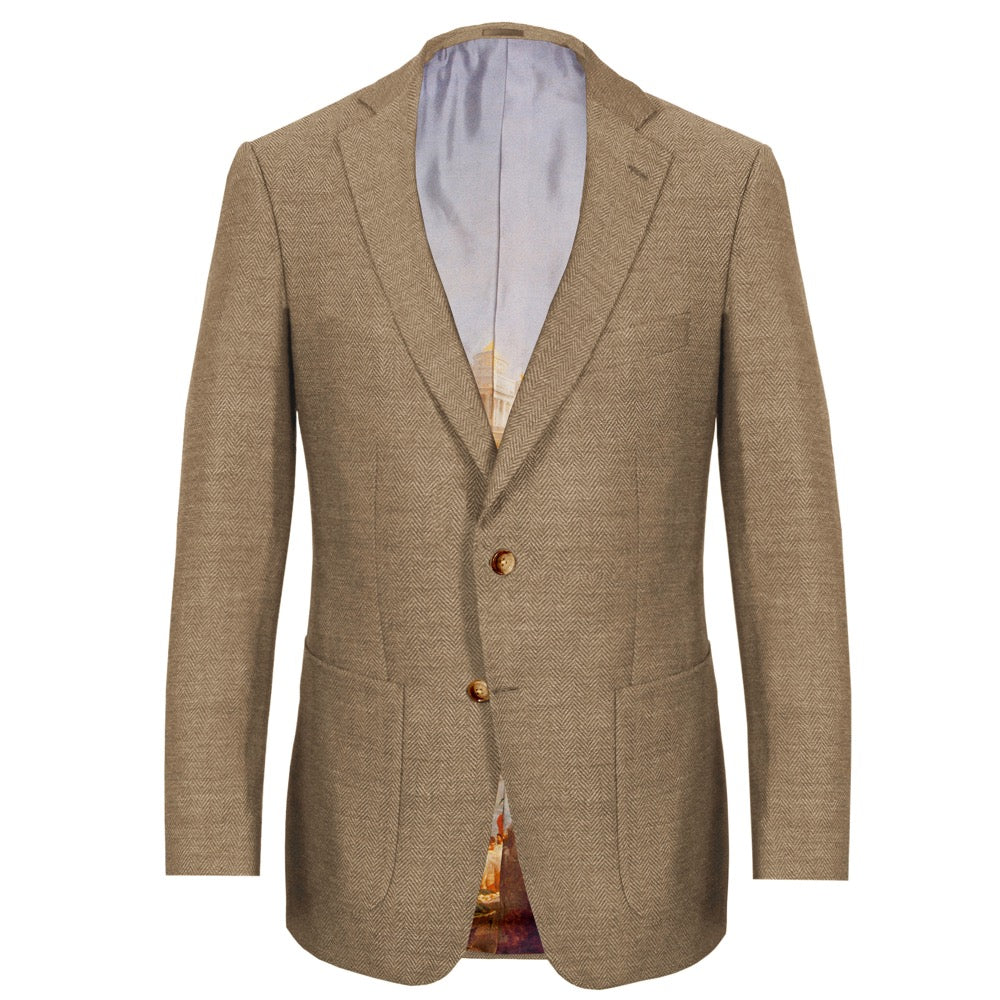 Cappuccino Herringbone Merino Wool Jacket
£[Price]
Cappuccino Herringbone Merino Wool Jacket
£[Price]
 The Deliverance - Ruggiero and Angelica Pocket Square
£[Price]
The Deliverance - Ruggiero and Angelica Pocket Square
£[Price]
 Blue, Cream & Ecru Stripe Shantung Silk Tie
£[Price]
Blue, Cream & Ecru Stripe Shantung Silk Tie
£[Price]
 Light-Grey Herringbone Wool-Blend Jacket
£[Price]
Light-Grey Herringbone Wool-Blend Jacket
£[Price]
 Burnt Yellow & Blue Floral Repeat Silk Tie
£[Price]
Burnt Yellow & Blue Floral Repeat Silk Tie
£[Price]
 Blue Geometric Silk Pocket Square
£[Price]
Blue Geometric Silk Pocket Square
£[Price]
Frequently Asked Questions
Your Questions Answered
What is the actual difference between business casual and smart casual?
Business casual starts with a suit and relaxes it: jacket and trouser stay matched, the tie becomes optional and accessories stay minimal. Smart casual starts with a casual outfit and dresses it up: jacket and trouser are deliberately mismatched, and detail, texture and accessories do most of the work. The simplest test is whether the jacket and trouser still belong to the same suit. If they do, you are in business casual. If they have been separated on purpose, you have moved into smart casual.
Can you wear a tie with a smart casual outfit?
Yes, and it is one of the more effective ways to sharpen a casual outfit without making it look like business wear. A knitted tie or a textured silk tie worn under a field jacket or overshirt reads as a deliberate styling choice rather than a formal requirement. The trick is pairing it with something practical, a field jacket, a corduroy jacket or an overshirt, rather than a tailored blazer, which would simply turn the look back into business casual.
What jacket works best for a smart casual outfit?
Field jackets, casual sports jackets cut in texture-rich cloths such as houndstooth or corduroy, and lighter linen blends all work well. The common thread is texture and a workwear-influenced cut rather than a sharply tailored silhouette. A jacket that could pass for half of a suit will always pull a smart casual outfit back towards business casual.
Is smart casual appropriate for a wedding?
For most destination and summer weddings, yes. A light, unstructured wool-linen jacket in blue, tobacco or forest green, paired with a cream open-collar shirt and lighter trousers, sits comfortably within most smart casual wedding dress codes. It is worth checking the invitation first: a small number of weddings still specify business casual or full tailoring, and the two are not interchangeable.
Can you wear smart casual to a job interview?
It depends heavily on the company. For a tech business or a creative industry, business casual broken into separates, a windowpane or houndstooth jacket with a solid trouser, classic shirt and tie, tends to land better than a full suit. For more traditional industries, business casual rather than full smart casual remains the safer starting point. Dressing slightly smarter than expected is rarely the wrong call.
To view the full collection click on the button below.