

What to Wear to Wimbledon: A Menswear Guide to SW19
Wimbledon insists it has no dress code for spectators, which is true in roughly the way a country house insists it has no rules about boots in the hall. Turn up in shorts and a vest and nobody will turn you away. Turn up looking as though you understand the occasion, and the difference is immediate. This guide to what to wear to Wimbledon covers that gap: the blazer that earns its place on Henman Hill, the standard the Royal Box actually expects, and the small mistakes that give away a first-timer. The video below catches a handful of the better-dressed regulars queuing at SW19 this year, and this guide builds out everything it does not have time to cover.
Enter our prize draw to win 4 style guides and £500 to spend
Shop the Video
 Bronze Spot Shantung Silk Tie
  Chamonix-Martigny Pocket Square
  Navy-Blue Check Wool-Linen Blend Jacket
  Heathered Navy & Ivory Stripe Silk Blend Tie
  Paseo a orillas del mar by Joaquín Sorolla Pocket Square
  Light-Brown Stripe Cotton-Blend Jacket
  Pale Blue & Red Repeat Silk Tie
  The Boulevard Montmartre in Spring Pocket Square
 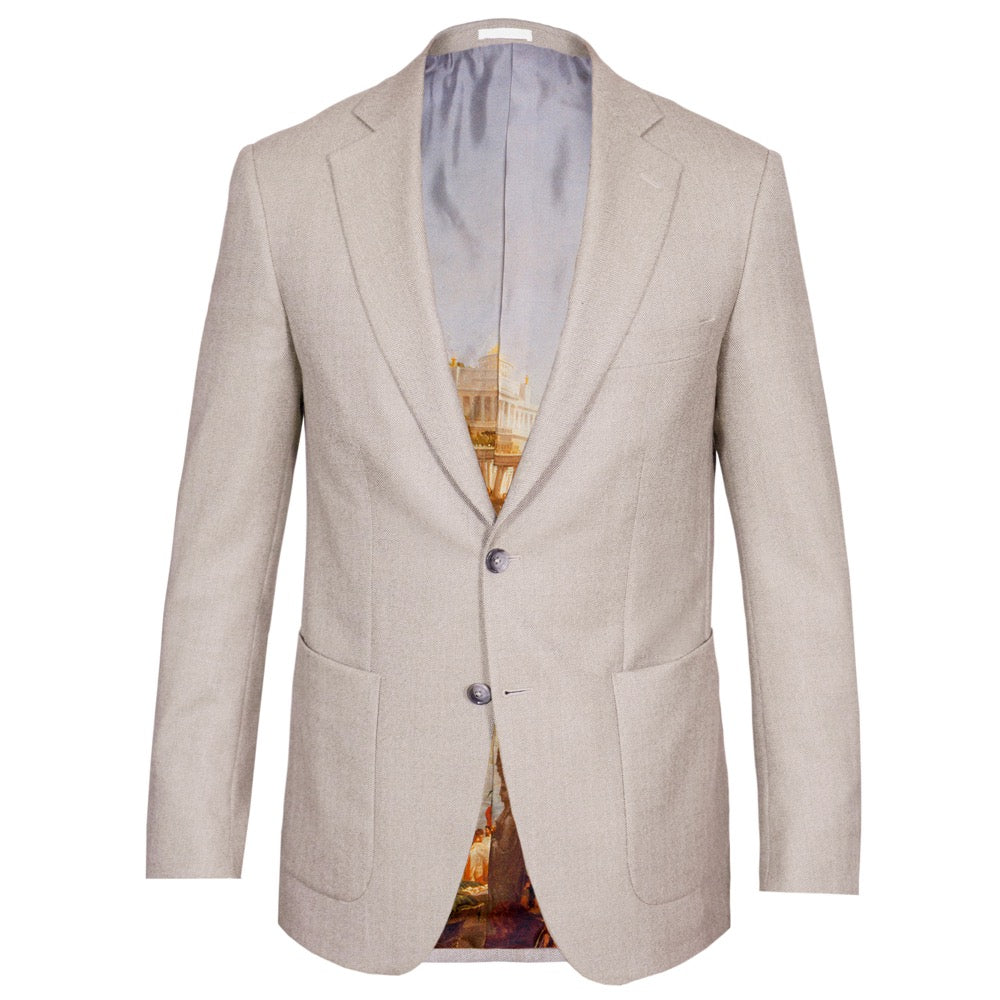 Biscuit Herringbone Wool Jacket
  Sandstone & Navy Stripe Silk Blend Tie
  The Grand Canal, Venice by Turner Pocket Square
  Navy Waxed Cotton Weekender
For more styling tutorials, subscribe to our channel
Subscribe to Our ChannelThe unwritten code
Why Wimbledon Has No Official Dress Code, Except When It Does
Ask the All England Club directly and you will be told, correctly, that there is no dress code for general admission. Henman Hill does not check collars. The queue, that great British institution with its own folklore and its own etiquette manual, has never once asked anyone for a tie. And yet stand at the gates on the first Monday and watch what people are actually wearing, and you will notice a dress code has formed anyway, unofficial, unenforced, and almost universally observed by anyone who has been before.
The honesty gap opens once you move toward hospitality. The Royal Box, the Members' Enclosure, and most of the debenture and hospitality suites around Centre Court and Court One operate on a different understanding entirely. Nothing is printed on the ticket, but everyone who has sat in one of those seats knows that jeans, trainers, and anything resembling sportswear will get a long look from the stewards even if it never gets an outright refusal. Wimbledon's genius is that it never has to write the rule down. The expectation does the work instead.
The contrast with somewhere like Royal Ascot is instructive. Ascot checks its dress code at the gate: hemlines, hat requirements, and jacket lapels are all assessed before anyone is allowed through. Wimbledon does none of this. It simply trusts that regular attendees already know the standard, and lets the crowd enforce it informally instead. Walk the grounds on any afternoon during the Championships and you will see the proof of that trust everywhere: blazers far outnumber t-shirts, even on the hottest days, not because anyone was told to wear one but because everybody else seemed to have had the same idea.
The default choice
Why the Blazer Is Wimbledon's Real Uniform
Nobody has ever mandated the blazer at Wimbledon, which is precisely why it has become the closest thing the day has to a uniform. It solves a problem that is specific to this particular event: you are sitting outdoors for several hours, the morning is cool, the afternoon turns warm, and you may at any point be required to look as though you belong somewhere considerably grander than a plastic seat with a programme balanced on your knee. A jacket does all of that without trying.
Navy is the obvious starting point, and for good reason. It works against the green of the courts rather than fighting it, it photographs well, and it gives you somewhere respectable to put your sunglasses when the sun finally arrives, which at Wimbledon is never guaranteed and always sudden. A hopsack weave earns its place here over anything heavier. The open construction breathes in a way that a tightly woven worsted simply will not, and by the third set on Court 12 you will be grateful for the difference.
What goes underneath matters almost as much as the jacket itself. A tie is entirely optional on the general grounds, and an open-necked shirt in a soft cotton or linen blend is both more comfortable and more in keeping with how most of the crowd dresses. If you are moving on to a hospitality suite later in the day, a tie folded into a breast pocket costs you nothing and saves you a change of plan. Keep the jacket itself on the lighter side of construction too: a soft, lightly structured shoulder copes far better with hours of sitting and standing than anything built for a boardroom.
There is a practical case, too, for treating the jacket as separate from the trouser rather than defaulting to a matching suit. Trousers that have been sat in for two or three hours on a narrow bench crease in ways a lounge suit was never designed to forgive, and separates let you retire the jacket the moment the sun gets serious without the rest of the outfit falling apart.
Stone and olive hopsack jackets carry the same practical advantages as navy and read slightly less corporate, which suits the relaxed mood of the general grounds particularly well. A barely visible check, the kind only noticed up close, adds a little interest without competing with whatever the tie or pocket square is doing. A single-breasted, two-button cut remains the most versatile choice: comfortable to wear open in the heat, and smart enough to button up for hospitality without ever looking like it is trying too hard.


Dressing for heat
What Fabric Works Best for a Day at SW19
The English summer has never once read the forecast it was given, and Wimbledon fortnight is where this becomes a wardrobe problem rather than a mild inconvenience. You need cloth that copes with both ends of the day: the queue at nine in the morning, when a breeze comes off the courts and the grass is still wet, and Centre Court at four in the afternoon, when the roof is open and the sun has nowhere else to be. Layering does more here than heavy cloth ever could. A fine knit worn under the jacket, rather than instead of the shirt, gives you a layer to shed as the day warms without undoing the outfit, and it solves a real problem: standing in a queue at eight in the morning in July feels closer to autumn than most people expect.
Linen and linen blends do more of the work than people give them credit for. Yes, they crease, but a crease at Wimbledon reads as a long, well spent day rather than carelessness, in a way it never quite manages in a boardroom. A linen jacket over an open-necked shirt covers the warm hours, and a lighter wool or wool-cashmere blend tie folded into a pocket means you are never caught out if you move from the Hill to a hospitality suite later in the day. Cotton trousers in a pale stone or a mid grey are the most useful thing you own for this particular fortnight: cooler than flannel, smarter than chino shorts, and entirely unbothered by which enclosure you end up walking into. Pure linen trousers are the one place this logic runs out. The fibre does not spring back the way a linen-cotton or wool blend does, and after two hours of sitting you will look as though you slept in a hedge. Save the linen for the jacket and let the trouser do the more forgiving job underneath.
Shirts deserve the same thinking. A lightweight Oxford or a fine poplin in white, pale blue, or a soft stripe breathes considerably better than anything heavier, and pale colours reflect heat across a long afternoon better than anything dark. Save bold pattern for the tie or the pocket square rather than the shirt itself. The eye can only take in so much at once, and a quiet shirt gives the rest of the outfit somewhere to do its work.
Pack for rain anyway. The roof over Centre Court has made play more reliable, but the queue and the outside courts have no such protection, and a sudden shower at Wimbledon has ended more than one carefully planned outfit. A lightweight wool overcoat, the kind that folds into a bag without complaint, is worth having on the worst-forecast days. Nobody minds carrying a coat they did not need. Everybody minds needing one they did not bring.
Colour with intent
How to Wear a Hint of Wimbledon Green Without Looking Like Staff
Wimbledon has a colour scheme of its own, the dark green and purple that covers everything from the scoreboards to the staff uniforms, and there is a genuine temptation to nod to it somewhere in an outfit. Handled well, this reads as someone who has thought about the day. Handled badly, it reads as someone who has been mistaken for the ground staff.
The safest place to bring in a touch of green is a pocket square rather than a jacket or a trouser. Our Chamonix-Martigny pocket square, printed from a 1930s railway poster of the valley below Mont Blanc, carries exactly this kind of muted forest green alongside warm ochre and alpine white, which reads as a considered detail rather than fancy dress. Paired with a warm bronze shantung tie rather than anything literally green, the whole combination sits happily against navy, tan or stone without ever looking as though it was chosen to match the courts. It is, in fact, the exact pairing worn in the video above.
Purple is worth leaving alone almost entirely. It reads far more literally as branding than green does, and paired with the same dark shade it is easy to end up looking like part of the signage rather than a guest at the event. If you want a nod to the colour scheme, green carries it. Purple rarely does.
The finishing details
Shoes, Hats and Accessories That Belong at Wimbledon
Shoes matter more at Wimbledon than the relaxed setting suggests, mostly because you will be on your feet for long stretches between the queue, the Hill, and the walk between courts. A leather loafer or a clean suede derby does the job better than a trainer ever could, smart enough for hospitality, comfortable enough for the walking, and considerably more forgiving of a damp lawn than anything with a fabric upper.
A panama or a soft trilby earns its place on the hottest days, less for the look than for the genuine usefulness of shade when you are sitting in direct sun for an entire set, though it is worth taking off the moment you are seated. There is very little point shading yourself from sun you are no longer sitting in. Sunglasses are not so much a styling choice as a practical requirement against a grass court on a clear afternoon. Where a pocket square or tie gives you room to enjoy yourself a little is in colour. Navy, tan, and copper stripes all sit naturally against the greens and blues of the grounds, and a pocket square with a touch of teal or a quiet illustrative print is a knowing detail rather than a costume.
The smaller details carry more weight than they should. Socks that match the trouser rather than the shoe avoid an unfortunate gap of bare ankle every time you sit down, which at Wimbledon you will be doing often. A leather belt that matches the shoe is a small piece of consistency worth bothering with. A simple watch does more for an outfit at Wimbledon than anything overtly sporty, partly because you will spend a fair amount of the day checking how long the next changeover is taking. If you want a single trick that reads as more considered than it actually is, pick one accent colour and let it turn up twice: a pocket square that echoes the tone in your socks, or a tie that picks up the same shade as the jacket lining you can just see when it moves. It is a small thing to notice and a smaller thing to do, which is exactly why it tends to stand out.
Shop the Finishing Touches


Formal seating
Dressing for the Royal Box, the Members' Enclosure and Debenture Seats
If you find yourself with a seat in the Royal Box, the Members' Enclosure, or one of the hospitality suites that ring Centre Court and Court One, the unwritten rule becomes a great deal less unwritten. The standard expected here sits close to what you would wear to a smart wedding or a significant client lunch: a tailored jacket, a collared shirt, proper trousers, and shoes that have seen polish more recently than they have seen a beach. Jeans, trainers, shorts, and anything branded as sportswear are the fastest way to feel conspicuous in the wrong direction.
A full suit is rarely required outside the most formal corners of the Royal Box itself, but a jacket is essential. Treat the invitation the way you would treat an invitation to a member's enclosure at any major sporting fixture: smart, tailored, and slightly more formal than you think the weather warrants. The seats are excellent. Dress as though you know it.
General Grounds
- No enforced dress code
- Smart casual is the unofficial norm
- A blazer and open collar covers most situations
- Comfortable shoes for walking between courts
Royal Box & Hospitality
- Jacket expected at minimum
- Collared shirt, proper trousers
- No jeans, trainers, or sportswear
- Shoes with a genuine shine, freshly polished
Headwear is worth a separate thought here. Panamas and trilbies are entirely at home on the general grounds and on the Hill, where shade matters more than formality, but most men remove them once they move indoors into a hospitality suite or the Royal Box itself, in keeping with ordinary indoor etiquette. A tie is rarely compulsory even at this level, but it tends to get worn anyway, simply because most of the room has made the same decision you are about to make.
Debenture seats sit a notch below this and are more forgiving than most people assume. The club does not technically require a jacket and tie in the debenture restaurants and bars, but the guests who use them tend to dress up regardless, simply because the day calls for it. This is the area where a well-cut odd jacket, a proper tie and a good pair of trousers earns its keep: formal enough to fit the room, comfortable enough to survive several hours of tennis either side of lunch.
Practical matters
What to Carry: Bags and Layers for a British Summer
Wimbledon also limits each spectator to a single bag, roughly 40 by 30 by 30 centimetres, which puts real pressure on whatever you decide to carry. Whatever it is needs to hold a folded layer for when the temperature drops without warning, sunscreen for when it does not, and ideally survive being wedged under a seat for six hours without looking as though it has been.
A structured weekender in waxed cotton does this considerably better than the tote you have been meaning to retire. It keeps its shape when it is half empty, closes properly against a sudden downpour, and looks equally at home carried through the gates as it does slung over one shoulder on the walk back to the tube, thanks to the webbed strap built into the design. Our waxed cotton weekenders collection covers exactly this kind of practical case, and is worth a look before the day arrives rather than the night before.

British summer weather being what it is, a compact umbrella earns its place in that bag more often than you would like at a tennis tournament. Play does stop for rain, and when it does, the difference between a dry jacket and a ruined one usually comes down to whether you bothered to pack something the size of a large water bottle. The same logic applies to a light knit or gilet folded small enough to disappear into a side pocket. Centre Court in the evening, once the sun drops behind the stands, is considerably colder than the queue felt at nine in the morning.
All-day versatility
Building One Outfit That Works From the Queue to Dinner After
Few sporting fixtures ask as much flexibility of an outfit as Wimbledon does. You might queue from early morning, walk the grounds through midday heat, watch from Centre Court in the afternoon, and find yourself at dinner in town that evening, all without the chance to change. The trick is choosing pieces that move between registers rather than packing for each moment separately.
A blazer does most of this work on its own. Worn open over a linen shirt with the sleeves rolled, it reads as relaxed enough for the queue and the Hill. Buttoned, with the tie restored from your pocket and the sleeves down, the same jacket carries you into a hospitality suite or a restaurant later without missing a beat. The trousers underneath should be doing similar double duty: a cotton or lightweight wool in a colour that works as easily with a polished loafer as it does with the slightly more relaxed shoe you wore to queue.


Pack light rather than packing twice. A spare tie and a clean pocket square take up almost no room and solve the problem of looking exactly as you did at nine in the morning by the time dinner arrives at nine in the evening. The day is long. The outfit does not need to change to keep up with it, provided you chose it with that length of day already in mind.
Putting it together
Three Wimbledon Outfits, Depending on Where You're Sitting
Grounds pass or an outside court. An odd jacket in linen or wool-linen, an open collar or a knitted tie you can loosen without looking dishevelled, trousers chosen for comfort over match, and loafers rather than anything that laces. This is where you can experiment a little with colour and get away with taking the jacket off entirely once the sun is properly out.
Hospitality or a debenture seat. A slightly more structured jacket, ideally a wool-linen check or hopsack, worn with a tailored trouser, a conventional tie and a pocket square that does some of the talking. Smart enough for the restaurants and bars that come with the ticket, still comfortable enough for an afternoon on Centre Court.
Royal Box or Members' Enclosure. A proper lounge suit, or a matching blazer and trouser if you prefer, worn with a conventional tie and no room for interpretation. This is the single occasion in the whole guide where the safe choice and the correct choice are exactly the same thing.
Centre Court and Court One raise the register slightly further still, less because of any rule than because you are more visible, with several thousand people around you and the cameras occasionally finding their way to the crowd. The queue has its own culture worth knowing too: overnight campers dress for comfort first, then change into something smarter once the tents come down and the morning admission begins. Nobody minds the transition. It is one of the few places at Wimbledon where the gap between practical and presentable is openly accepted rather than quietly managed.
Whichever version applies to you, the underlying logic stays the same: choose cloth that survives sitting as well as standing, keep colour deliberate rather than decorative, and get the small details right, because at Wimbledon, more than at almost any other sporting fixture, people are actually looking.
Common missteps
What Not to Wear to Wimbledon
Replica tennis kit is the most forgivable mistake and still worth avoiding. Wearing the sport you are watching, rather than dressing for the watching of it, reads as a tourist's instinct rather than a regular's. Head-to-toe white deserves a specific mention of its own: players are required to wear an all-white kit under the club's rules, so a spectator turning up in the same colour scheme tends to look less like a considered choice and more like someone who has wandered onto the wrong side of the net.
Football shirts and other branded sportswear fare worse again, and will draw a long look in hospitality areas regardless of how comfortable they are. Flip-flops and beach sandals are the other recurring error, usually committed by someone who has correctly identified that the day will be warm and incorrectly concluded that footwear is therefore optional. The walking between courts and the general unpredictability of an English lawn in summer both argue for a proper sole.
Novelty items are their own small category of error: tennis-ball print trousers, promotional caps handed out at the gate, stag-do fancy dress that shows up around the outside courts most years and rarely photographs as well as it felt in the group chat the night before. A blazer and an open collar will always look more like you understand the day than a costume built around its theme.
Finally, resist the urge to overdress for the ticket you actually hold. A full three-piece suit on a grounds pass, in July, with no shade and several hours of standing ahead of you, is a test of endurance rather than a style statement. Match the effort to the seat, and the outfit tends to take care of itself.
Final thoughts
Dressing Well for Wimbledon Is Not Complicated
None of this requires new rules learned by heart. A jacket that breathes, comfortable shoes built for hours of standing and walking, and an honest read of which part of the grounds you are sitting in will see you through the day comfortably and appropriately wherever you end up. Wimbledon rewards the same instinct that good dressing rewards everywhere else: pay attention, make a small effort, and let the occasion tell you how far to take it.
Frequently asked questions
Your Wimbledon Dress Code Questions Answered
Is there an official dress code for Wimbledon spectators?
No. General admission areas, including the queue, Henman Hill, and the outside courts, have no enforced dress code. Most regular attendees still dress smart casual as an unwritten norm. The expectation tightens considerably in the Royal Box, Members' Enclosure, and hospitality suites, where smart, tailored dress is expected even though it is not printed on the ticket.
What should men wear to Wimbledon?
A lightweight blazer in navy or a breathable hopsack weave, worn over an open-necked shirt, covers most of a day at Wimbledon comfortably. Cotton or linen trousers in a pale tone are cooler than flannel and smarter than shorts. Add a panama or trilby and sunglasses for direct sun, and pack a foldable lightweight coat in case of rain.
Do you have to wear a jacket and tie to Wimbledon?
Only in specific areas. A jacket and tie are required for men in the Royal Box and, in practice, expected in the Members' Enclosure. Debenture holders are encouraged to dress up but are not technically required to wear a jacket and tie in the restaurants. For a standard grounds pass, there is no such requirement at all, though a blazer still tends to look better than the alternative.
Can you wear jeans to Wimbledon?
On the general grounds, jeans will not get you turned away, though they sit at the more casual end of what regular attendees tend to wear. In the Royal Box, Members' Enclosure, or any hospitality suite, jeans are generally considered too casual and are best avoided in favour of proper trousers.
What is the dress code for the Wimbledon Royal Box?
The Royal Box expects a standard close to a lounge suit: a tailored jacket, collared shirt, proper trousers, and polished shoes. Jeans, trainers, shorts, and sportswear are not appropriate. The same general standard extends to most of the hospitality suites and the Members' Enclosure around Centre Court and Court One.
Is a full suit or separates better for a day at Wimbledon?
Separates, in most cases. An odd jacket over trousers chosen for comfort copes far better with several hours of sitting, changeable weather and the option of removing the jacket entirely once the sun is out. A full suit is worth reserving for the Royal Box or Members' Enclosure, where the standard calls for it specifically.
Should you wear linen trousers to Wimbledon?
It is worth avoiding pure linen trousers for a day that involves several hours of sitting, since the fabric creases badly and does not recover well. A lightweight cotton or wool-blend trouser holds its line far better through a long afternoon and still feels appropriate for the heat.
What shoes should you wear to Wimbledon?
A leather loafer or clean suede derby is the most practical choice: smart enough for hospitality areas, comfortable enough for the walking between courts and the queue, and more weather resistant than a fabric trainer on a damp lawn. Flip-flops and beach sandals are best left at home regardless of the forecast.
To view the full collection click on the button below.