

The Suit is Dead
The suit is not dead. It is merely attending fewer meetings. Walk through most London offices today and what you see are jackets and odd trousers: men dressed with thought, but not in the matched cloth that once served as the default answer to the question of what to wear. The question has not changed. The answer has.
Shop the Video



For more styling tutorials subscribe to our channel
Subscribe to Our ChannelThe New Calculus
Is the Suit Dead? What "Formal" Actually Means in the Way Men Dress Now
Nobody who works on Savile Row will tell you the suit is dead. What they will tell you, if pressed, is that the suit has been demoted from duty to occasion, and that the shift happened so gradually most people didn't notice until it was already complete. The man walking into a business meeting in a well-cut sports jacket, a white shirt, a tie, and a pair of charcoal trousers is now, by any reasonable measure, the best-dressed person in that meeting. That he is wearing separates rather than a matched suit has stopped mattering to everyone in the room except, possibly, him.
The evidence for this is anecdotal but pervasive. Walking through most parts of London today, the full lounge suit is genuinely rare on working men below a certain level of institutional seniority. It appears reliably at funerals. It surfaces at informal weddings where morning dress hasn't been specified. It shows up in the City of London and at the more traditional end of the financial and legal professions, where there are still unwritten dress codes policed entirely by the raised eyebrow. Beyond these redoubts, what you actually see are jackets: odd jackets worn with different trousers, with or without a tie, at every level of put-togetherness from "just made an effort" to "actually rather wonderful."
The argument that the suit is smarter than separates used to rest on the premise that matched cloth read as more formal than mixed cloth. This was true, and remains technically true in the sense that a morning suit outranks a lounge suit and a lounge suit outranks separates in any formal hierarchy you might construct. But in everyday life, the formality of an outfit is now conveyed almost entirely by the shirt and tie. Add those, alongside a structured jacket, and you are dressed at a level most contexts in 2024 would consider overdressed. The matching cloth has become a secondary consideration that few people outside the trade are still actively tracking.
The Formality Question
Why a Sports Jacket with a Shirt and Tie Is Now Smart Enough for Almost Any Business Occasion
Here is the practical version of this argument. You have a meeting: a client presentation, a first encounter with someone whose view of your professionalism will matter. What do you wear? The answer, in almost every such situation today, is a well-cut sports jacket in a structured cloth, a well-pressed shirt, a tie that has been thought about rather than grabbed, and trousers that fit. Specifically, probably charcoal flannel trousers, which remain the single most useful trouser ever put into production. Add a plain Oxford cap toe in black or a dark brown brogue and you are dressed for that meeting, and the meeting after it, and the dinner that follows if it comes to that.
The exceptions remain real. If you work in a very traditional institution, or in law at a partnership that regards the lounge suit as the minimum requirement for a certain kind of client relationship, the suit retains its authority. There are also situations where arriving in a jacket and odd trousers reads as studied casualness rather than considered dressing: a formal interview for a senior position, a meeting where everyone else will be in a suit and the advantage of conformity outweighs the advantage of interesting trousers. Know the room. But these situations have contracted noticeably over the past decade and continue to do so.
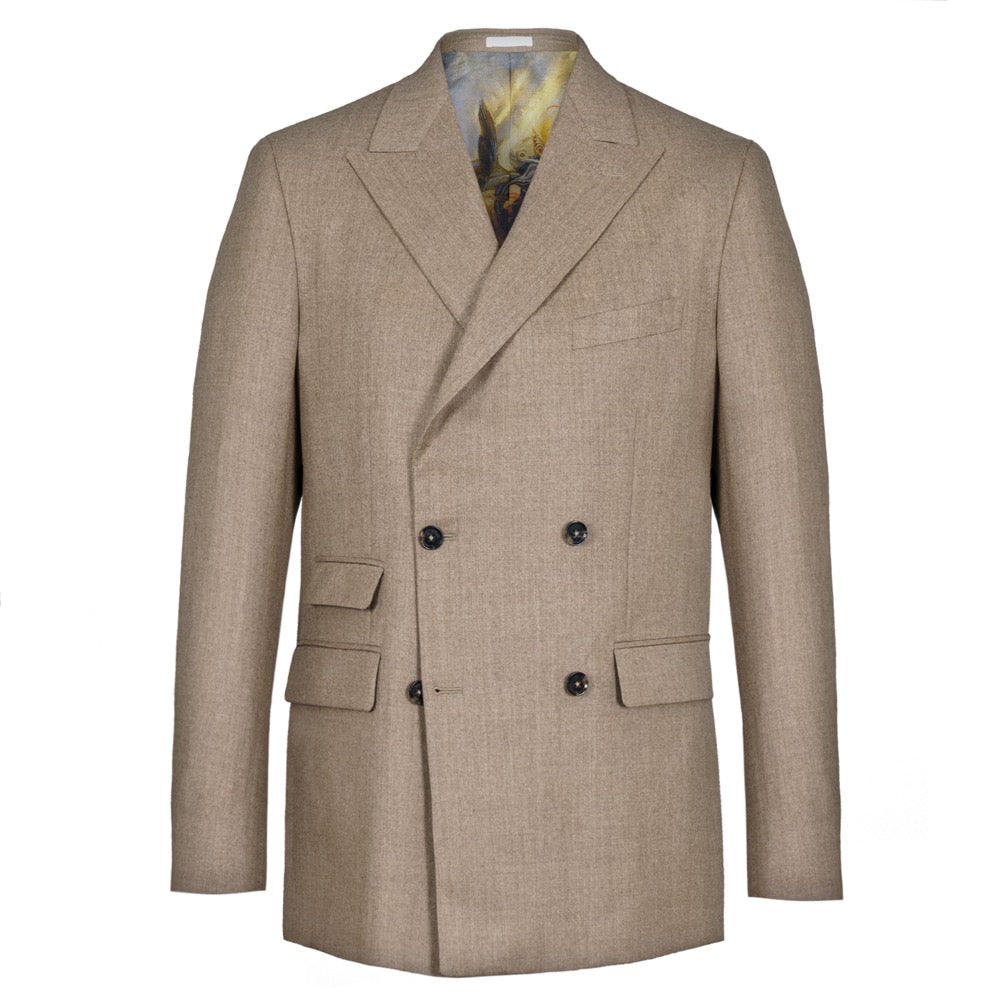
What has filled the space is the dressed-up separates look: a structured jacket, a proper shirt, and a silk tie from the collection that says the wearer has thought about their appearance without making it their entire personality. This is a harder balance to achieve than it sounds. The suit outsources certain decisions: the trousers are already chosen, the level of formality already fixed. Separates require judgment at every step, which is both the difficulty and, for anyone who actually enjoys getting dressed, the pleasure of them.
You can be well dressed without being too formal. That is, when you think about it, a more interesting achievement than simply being formal.
The Case for Flexibility
What a Sports Jacket Can Do That a Suit Cannot: The Versatility Argument Made Specific
The versatility case for the sports jacket is not new, but it tends to get stated in general terms when the specifics are where the actual value lives. A sports jacket can be worn with: charcoal flannel trousers, which push it toward formal; mid-grey flannels, which keep it balanced and easy; dark navy trousers, which give it a different kind of authority; stone-coloured chinos or a cotton drill trouser, which take it to smart weekend; and cream or off-white trousers in summer, which take it somewhere between elegant and slightly reckless in the best possible way. Each trouser combination creates a different outfit, requires different shoes, and works at a different occasion. The jacket itself doesn't change. Its character does.
Shoes follow the same logic. A dark brown brogue is the obvious companion to most odd trouser combinations. Suede loafers or suede chukka boots take the whole thing somewhere considerably less formal without sacrificing the sense of effort. With navy trousers and brown suede loafers, a decent sports jacket reaches a kind of smart-casual that the navy suit, for all its qualities, genuinely cannot. The navy suit with suede shoes reads as a style experiment. The navy trouser and sports jacket with suede shoes reads as a man who knows what he is doing on a Friday.
Knitwear extends the range further. A fine merino or cashmere crew neck under a sports jacket, in place of a shirt and tie, works comfortably from a smart weekend lunch to the kind of informal office that runs on visible effort rather than formal convention. A suit can manage a similar trick, and many men attempt it, but the relationship between a suit jacket and a crew neck is more awkward: the suit jacket remembers what it was made for and is not entirely willing to forget. The sports jacket accepts the crew neck without comment and moves on.
Travel is where the jacket's practical advantages concentrate most usefully. A single well-chosen sports jacket packed alongside a selection of trousers, shirts, and ties represents more distinct outfit possibilities than two suits in the same volume of luggage. The suit is a single proposition. The jacket is a system, and systems travel better.


The Capsule Argument
How to Build a Wardrobe Around Sports Jackets and Odd Trousers
The mathematics of a separates wardrobe are more interesting than they first appear. Take two sports jackets and three pairs of odd trousers. Between them, those five pieces generate six distinct jacket-and-trouser combinations before you have touched a shirt, a tie, or a shoe. Add a third jacket and a fourth trouser and the combinations multiply considerably faster than the number of items you have had to buy or store. Compare this with the suit wardrobe, in which each suit is a fixed unit: three suits gives you three formal outfits. Three jackets and four odd trousers gives you twelve, and those twelve can be run at different levels of formality by varying the shirt, tie, shoe, and knitwear choice.
The practical consequence is that a wardrobe built primarily on separates is, counterintuitively, easier to manage over time. The pressure on each individual piece is lower. A jacket that has worn at the elbows does not take an entire suit with it when it retires; the trousers continue their useful life with a different partner. Trousers that have grown shiny at the seat can be replaced without committing to a new jacket. Each piece sustains independence from the others, and the wardrobe as a whole ages more gracefully and with fewer forced decisions.
There is also the question of pleasure, which tends to get left out of the practical accounting. The decision of what to wear becomes more interesting when the components are genuinely interchangeable. Opening a wardrobe of suits is a matter of degree: darker or lighter, heavier or lighter, which shirt and tie. Opening a wardrobe of sports jackets and odd trousers invites a different kind of decision: which combination serves the occasion, what has not been worn recently, what might not obviously work but is worth trying. The separates wardrobe restores a certain amount of genuine choice to getting dressed, which is, depending on your disposition, either an improvement or a minor daily problem you hadn't previously had. Most people, once they make the transition, find it the former.
Explore the Tailored Jackets Collection
Still Worth Wearing
When a Suit Still Makes Sense in a Wardrobe Built Around Separates
Having made the case for the sports jacket, it is worth being clear about what the suit still does that no jacket-and-odd-trouser combination quite replicates. The suit at its best has a particular kind of unity: the eye reads the whole thing as a single deliberate statement in a way that separates, however well chosen, cannot entirely match. There are occasions where that unity is precisely what is required, and occasions where choosing to wear a suit is itself a statement rather than mere compliance with a dress code.
The obvious formal occasions remain obvious. A funeral calls for a suit, or at the very least a dark jacket and trousers that produce something functionally close to one. An informal wedding, where the invitation specifies neither morning dress nor black tie, is still an occasion where a suit shows respect for the event. Black tie, which some men find themselves wearing more often than a lounge suit these days, occupies its own territory and its own conventions entirely separate from this conversation.
Beyond the duty occasions, there is the case for the suit as a deliberate stylistic choice: the counter-programming value of putting one on in a world where most of the people around you have abandoned them. The man who turns up to a smart dinner in a well-cut suit among a room of separates has made a choice, and choices are visible. Worn this way, as preference rather than prescription, the suit carries more weight than the suit worn because there seemed no alternative. If you already own good separates and occasionally want to change the register of how you appear, the suit remains the most efficient way to do it. Consider it a change of pace rather than a retreat.
The Advanced Move
How to Break Up a Suit and Wear the Jacket as a Separate
Most wardrobes contain suits that are no longer being worn as suits. The occasion that bought them has passed, or the suit has aged out of its original purpose, or the wearer has simply grown more comfortable in separates and the suit now hangs at the end of the rail in the manner of someone who has missed several trains and stopped expecting the next one. In some of these cases, the jacket can have a useful second life worn with odd trousers.
Whether this works depends almost entirely on the fabric and the cut. A natural-shouldered suit in a substantial tweed, flannel, or hopsack can, with some confidence, yield a jacket that reads as a convincing sports jacket. The cloth looks purposeful in its own right because such fabrics are not exclusively associated with matched suiting. A smooth barathea or a high-twist worsted, on the other hand, will almost always read as a suit jacket without its trousers: the fabric carries the memory of what it was made for, and no amount of odd trouser will shake it.
Cut matters equally. A softly structured jacket, particularly one with a natural British or Neapolitan shoulder, departs more easily from its original context than a sharply built jacket with a formal military shoulder. The formal construction announces its origin. The softer construction is more willing to forget.
The practical caution: if you have been wearing a suit as a suit, the jacket will typically wear faster than the trousers. Once the imbalance becomes visible, the suit is already being disaggregated by default. Most people who successfully break up suits do so with garments they have already worn heavily as matched outfits rather than with recent purchases they have decided to treat as separates from the outset. The latter is possible, but it requires an unusual degree of commitment to the odd-trouser programme, and the matching trousers tend to age rather sadly in the meantime.
A Note on Terminology
Sports Jacket, Sports Coat, Blazer: What the Terms Actually Mean
The names for an odd jacket worn as part of a separates outfit are various and, depending on your background, firmly held. Sports jacket and sports coat are used interchangeably by most people who have been wearing them for any length of time, and the difference between the two is largely geographical and generational. In Britain, sports jacket is the common term. In America, sports coat has long been preferred, which turns out to be a preservation of older English usage: on Savile Row, tailors have coat makers rather than jacket makers, and a jacket has always been a coat in the trade vocabulary. American tailoring terminology, which is sometimes accused of being a colonial corruption, turns out in several instances to be the more historically accurate version. The grandfather who called it a sports coat was, in this particular respect, closer to Savile Row than the man who corrected him.
The blazer is a distinct matter. A blazer has specific characteristics that separate it from a sports jacket: its origins as a boating and club garment, its typically solid or striped cloth, its brass or gilt buttons, and the naval associations it carries. Wearing a blazer is a different proposition from wearing a sports jacket, and conflating the two is the kind of error that will be silently noted by the sort of people who pay attention to these things. A navy hopsack jacket with horn buttons is a sports jacket. A navy jacket with gilt double-breasted buttons and a breast pocket badge is a blazer. The difference matters, even if neither party in a meeting can always articulate exactly why it does.
What to call the garment in practice is less important than understanding what it is and how it functions. Any well-cut odd jacket, whatever the wearer chooses to call it, earns its keep through the combinations it enables and the ease with which it accepts different trousers, shirts, ties, and shoes. The tailored jackets collection is the place to start if you want to see what these garments can do in practice.
A Brief History
What Is a Lounge Suit? The Origin of a Name That Has Outrun Its Meaning
The lounge suit is, etymologically, a garment defined by where it was not supposed to be worn. In the late nineteenth century, when the term entered use, it described a jacket and trousers in the same cloth that was considered appropriate for the lounge, for country house weekends, for resort wear: any context that was demonstrably not the city and not the formal occasion. It was, at the time, informal attire. The frock coat and its successors were the formal town wear; the lounge suit was what you wore when you were, in the broadest sense, resting.
The anachronism is now complete. The lounge suit has become the formal garment, the thing required at weddings and interviews and the better restaurants, while the country weekends and resort occasions it was designed for are now handled by jeans and a good jacket. The word "lounge" still suggests, to anyone who has not been briefed on the etymology, something involving an armchair and a Sunday afternoon, which is precisely the opposite of what the term has come to mean in practice. The British dress code vocabulary has several such fossils embedded in it, and the lounge suit is among the most reliable.
What the history actually points to, and what matters for the way we dress now, is that the boundary between formal and informal in tailoring has always been more fluid than any particular era of dress codes makes it appear. The lounge suit was once considered too casual for a city office. The sports jacket was once considered too casual for a business meeting. Each garment has, in its time, made the transition from informal to acceptable to required. Which suggests that the sports jacket's current near-equivalence to the suit is not so much breaking new ground as following a well-established pattern of gradual formalisation. Give it another generation and the whole conversation will look as settled as the lounge suit at a funeral already does.
Frequently Asked Questions
Your Questions Answered
Is a sports jacket as formal as a suit for a business meeting?
In most professional contexts today, yes. A well-cut sports jacket worn with a shirt, tie, and a pair of charcoal or grey flannel trousers is smart enough for the majority of business meetings, client presentations, and professional occasions. The exceptions remain in very traditional sectors such as certain City of London institutions and established law firms, where a lounge suit is still the expected minimum. If you know the room, dress for it accordingly. Outside those specific contexts, a dressed-up sports jacket will often be the most considered outfit in the room.
What is the difference between a sports jacket and a suit jacket?
A suit jacket is designed as part of a matched set with trousers in the same cloth. A sports jacket is designed to be worn with different trousers in a variety of cloths and colours. Beyond intended use, the fabrics differ: sports jackets are often made in tweeds, hopsacks, checks, and texture-rich cloths chosen specifically to work against plain or contrasting trousers. A suit jacket in a smooth city cloth will almost always read as incomplete without its matching trousers. A sports jacket in a textured or patterned cloth looks purposeful on its own.
What trousers work best with a sports jacket?
Mid-grey flannel is the most versatile option and works reliably with almost any sports jacket. Charcoal flannel pushes the combination toward formal. Dark navy trousers are a strong alternative, particularly with brown or natural-toned jackets. Stone chinos or cotton drill trousers take things to smart-casual. Cream or off-white trousers work well in warmer months. The key principle is that the trousers should contrast with rather than closely coordinate with the jacket: the combination should read as a considered decision, not a near-miss with a suit.
What is a lounge suit and where does the name come from?
A lounge suit is a jacket and trousers in exactly the same cloth, sometimes with a matching waistcoat. The name dates from the late nineteenth century, when it described informal attire for a country house lounge, resort, or leisure occasion rather than formal town use. At the time it was casual wear. The irony is that it has since become the standard formal garment for most occasions, while the country weekends it was designed for are now handled by jeans and a good jacket. The word "lounge" has entirely outrun its original meaning.
Can you break up a suit and wear the jacket as a sports jacket?
Sometimes, and the fabric is the deciding factor. A natural-shouldered suit in tweed, flannel, or hopsack will generally yield a jacket that reads as a convincing sports jacket when worn with appropriate odd trousers. A sharply structured jacket in a smooth city cloth will almost always read as a suit jacket without its matching trousers. The softer and more textured the original cloth, the better the jacket's chances of a successful second life as a separate. A softly built, natural-shouldered jacket is worth attempting. A sharp-shouldered city worsted is rarely worth the effort.
What is the difference between a sports jacket and a blazer?
A blazer has specific origins as a boating and club garment, typically in a solid or striped cloth with brass or gilt buttons and clear naval associations. A sports jacket is an odd jacket in almost any appropriate cloth, intended to be worn with different trousers across a range of occasions. The terms are sometimes used interchangeably in casual conversation, but they describe distinct garments. A navy hopsack jacket with horn buttons is a sports jacket. A navy jacket with gilt double-breasted buttons and a breast pocket club badge is a blazer. Knowing the difference is the kind of thing that quietly separates the considered dresser from the one who is still working it out.
To view the full tailored jackets collection click on the button below.