

The History of The Suit
The suit has been declared dead with such regularity that the critics have worn out their suits attending the announcement. It began with a bankrupt king, survived industrialisation, two world wars, one disco decade, and an unfortunate encounter with very narrow trousers, and continues to appear at every summit table, every wedding, every moment that calls for a man to look as though he gave the matter some thought.
Shop the Video


For more styling tutorials subscribe to our channel
Subscribe to Our ChannelWhere the Modern Suit Began: King Charles II and 1666
The founding moment of the modern suit is not, as you might reasonably expect, a triumph. It is a failure of foreign policy combined with a plague, a fire, and a king who was, by any measurable standard, considerably short of funds.
Charles II, in 1666, was persuaded to simplify the dress of his court. What emerged was a long coat (contemporaries called it the Persian coat, which gives some indication of how enthusiastically anyone was claiming credit for it), a long waistcoat, and breeches reaching to the knee, all in the same plain dark cloth. The uniformity of fabric is the thing. Two pieces or three, whatever the silhouette, a suit is about cloth that agrees with itself. Everything else, across the three and a half centuries that followed, is refinement of that premise.
The restraint lasted, as restraint tends to when Charles II is involved, roughly as long as it took him to find something more interesting to do. He reverted. But the template held. The diarist Samuel Pepys noted the waistcoat's introduction as a mark of purposeful economy at court, and Savile Row still occasionally says vest without much acknowledgment of where the word came from.
How Riding Culture Changed the Shape of the Jacket
The next development of consequence came from the countryside, and specifically from the problem of sitting on a horse in a long coat. It is not, when you attempt it, a comfortable or dignified arrangement.
The English aristocracy, unlike their French counterparts (who were largely required to remain at court, which solved the horse problem by removing the horse), maintained country estates and rode on them. The Georgian long coat was shortened. Its front was cut away to allow a rider to sit without incident. The sleeve was redesigned to allow the shoulder to move. Everything you now take for granted when you put on a jacket, its length, its front opening, the way the sleeve sits, traces to the practical requirements of an English gentleman getting onto a horse in a way that suggested he did this regularly.
When anyone suggests that tailoring is merely decorative, it is worth noting that its whole grammar was invented to allow men to ride.
What Beau Brummell Actually Did for Men's Dress
Beau Brummell is sometimes reduced to the well-dressed friend of a well-dressed prince. His actual contribution to the history of men's clothing is more interesting, if rather harder to describe to anyone who thinks elaborate is a compliment.
At a time when European court dress involved powder, wigs, silk, and an aesthetic that placed spectacle above everything else, Brummell's position was simple: fine wool, clean linen, a dark coat, a pale shirt, a fit so precise that the effort was completely invisible. The goal was not to be seen to have tried. The goal was to look, without apparently having done anything in particular, exactly right. He understood this with such clarity that he applied it to trousers as well, moving men from breeches (rural, archaic) toward full trousers (urban, considered), taking a piece of working dress and making it appropriate for everywhere.
His most enduring contribution, though, was the idea that quiet confidence is more impressive than any amount of visible effort. If the outfit is announcing itself, something has gone wrong. It is a principle that the best-dressed men of every subsequent era have independently arrived at and believed to be entirely their own.
The Frock Coat and the Victorian Standard of Dress
The Victorians dressed according to a code, and the code was not optional. What you wore communicated who you were with a precision that would seem both exhausting and impressive today.
The frock coat ran the upper half of this system: a long, usually double-breasted jacket that had evolved from the overcoat, whose lapels were originally the practical fold of a coat that buttoned from chin to waist. Nobody closes a jacket from chin to waist any more (though the distance between current fashion and that particular practice is not, historically speaking, as great as one would hope). The lapels remain, entirely decorative, a structural memory of a function that vanished more than a century ago.
Below the frock coat in the hierarchy of occasion sat the lounge suit, shorter and single-breasted, appropriate for the seaside or the country and for nothing that carried real social weight. Edward VII, then still nominally the Prince of Wales (he would wait 59 years for the actual job), was photographed in what we would now recognise as a lounge suit in 1864. Within fifty years it would come to dominate everything above it.
How Edward VII Changed the Rules of Men's Tailoring
Albert Edward, Prince of Wales for an implausibly extended period before becoming Edward VII at 59, understood what it meant to be the most photographed man of his era in a way that suggests he would have found the modern celebrity industry entirely comprehensible.
His contributions to the standard wardrobe are numerous and specific. The dinner jacket began as his request to remove the tails from a tailcoat, a request that sounds modest and was apparently fairly radical. The garment reached America via a member of the Tuxedo Club in New York, which is why Americans call it a tuxedo and why Edward VII receives credit for a garment he had made entirely for himself. He gave the lounge suit its social legitimacy. He made the soft dinner shirt acceptable at a moment when the stiff alternative was obligatory. He championed the Norfolk jacket for country wear and the Prince of Wales check without, apparently, making any particular effort to do either.
What made him effective as a style figure was not merely that he relaxed conventions but that he knew which ones to relax. He was meticulous about occasion: you wore one thing shooting, another at Ascot, something else on a yacht. His informality was disciplined, which is the only kind that actually works.
Why the 1920s and 1930s Are Called the Golden Age of the Suit
The golden age label sticks because a suit from the 1930s can be worn today. A suit from the 1860s puts you in costume. The interwar silhouette had settled into something durable: structured shoulder, defined waist, jacket and trouser in agreement. The variety within it was considerable, single and double breasted, chalk stripe and pinstripe, lapels that came and went in width, but the underlying grammar was established.
Hollywood was the other factor. The style setters of the prewar period had been royalty and aristocracy, people who were always in public and always dressed for it. After the first world war, cinema replaced them. Fred Astaire, Cary Grant, Humphrey Bogart: men who were never off duty and never, apparently, wrinkled. The aspiration had moved from the hereditary to the aspirational (or at least the cinematically aspirational), and men's dress moved with it.
The Duke of Windsor sat between these two worlds. He preferred a high-waisted pleated trouser with a front crease, had his trousers made by an American tailor because Savile Row would not make them with a belt (Savile Row's position being that a man's trousers should stay up by force of tradition rather than hardware), and owned 55 suits at his death. He wrote, in one of his memoirs, that he was not particularly interested in clothes. This is one of the more improbable sentences in the literature of men's dress.
The Demob Suit, the Teddy Boy, and What Youth Culture Did to Tailoring
The demobilisation suit, issued to millions of returning British servicemen from 1945, was not received with uniform enthusiasm. The trade press noted, with some sharpness, that men who had spent six years fighting deserved something better than the economical cut they received. The demob suit entered cultural memory anyway, as a particular kind of garment: wide shoulders, wide lapels, the look of a country that had survived something and intended to continue.
More significant in the long run was what happened next, which was that young men in the 1950s began, for the first time in the recorded history of Western dress, deliberately dressing in ways that distinguished them from their fathers. Children had been dressed as small adults since at least the seventeenth century. The idea that a young man might look at his father's wardrobe and decide, quietly but firmly, to go elsewhere, was genuinely new.
The Teddy Boy movement combined Edwardian tailoring with American street culture and produced something that was neither and somewhat surprising: long jackets, narrow trousers, contrasting waistcoats, a silhouette that newspapers found alarming and historians have found interesting. It did not last, in its original form, for very long. The instinct behind it has proved considerably more durable.
The 1960s: When the Suit Was Taken Apart and Rebuilt
The 1960s were the decade in which men's dress underwent changes that, concentrated into five or six years, were more dramatic than anything in the three decades that followed. This is worth noting whenever someone suggests that fast fashion is a recent invention.
The mod movement began with British young men who were drawn to the style of American modern jazz musicians, who dressed sharply in a way influenced by postwar Italian tailoring: shorter jackets, slimmer fits, nothing showy. The connection back to Beau Brummell is genuinely traceable. The same principle was operating across three centuries and several continents: not the absence of effort but its complete concealment.
Carnaby Street ran, and this is worth noting, two streets from Savile Row. John Stephen eventually operated ten shops there, stocking clothes that could turn over in days. The Beatles arrived in Pierre Cardin-influenced collarless jackets and left, several years later, in Tommy Nutter suits. These streets were conducting a long conversation about the same question from different premises, and the question, in both cases, was the suit.
James Bond existed alongside all of this as a different kind of figure. Sean Connery's Bond, from 1962 onward, was conspicuously not a mod. Conservative in dress, establishment in bearing, cool in a way that had nothing to do with what was happening on Carnaby Street. The mod look and the Bond look were both, at root, about a suit. In almost every other respect they were opposites. Both were right, which is the interesting thing.
How Italian Tailoring Reshaped the Men's Suit
The Italian influence on men's tailoring is specifically a 1970s and 1980s story. Its central figure is Giorgio Armani, who removed from the suit its structure and discovered it was still, recognisably, a suit.
The canvas interlining, the padding, the architecture that had made a traditional jacket function as a kind of exoskeleton: Armani took these out and replaced them with something much lighter. The jacket did not collapse. It fell differently. Softer, more comfortable, more appropriate to heated offices than to the exposed moorland for which earlier construction standards had been, implicitly, designed.
He arrived at this via Nino Cerruti, who came from a textile family and whose understanding of cloth made the lighter construction achievable rather than merely desirable. The understanding that six different cloths in the same silhouette produce six entirely different garments is not a minor observation. It is one of the things that separates a serious approach to men's dress from an approximate one, and the Italian school rested substantially on it.
Southern Italian tailoring, the tradition of shorter, softer, less constructed jackets, became widely visible in the 2000s and 2010s as the internet brought its makers to a global audience for the first time. Social media distributed the vocabulary further. The instinct for softer construction has remained influential in the years since.
The Return of the Suit: Peaky Blinders and What Came After
The suit's most difficult recent period was the era of the super-skinny suit. The jacket shortened. The trouser narrowed. The lapel diminished to something of ambiguous purpose. The waistcoat, where added, arrived at different terms with the jacket than with the trouser, which is the kind of three-way disagreement that is visible from across a room. The look lasted, as several observers have noted, considerably longer than its merits warranted.
The recovery came from Peaky Blinders, a television series about a Birmingham gang in the years after the first world war, which reintroduced three-piece suits to a generation of young men who had largely concluded that tailoring was someone else's concern. The cuts may not have satisfied a purist at every point. They did not need to. They made the suit interesting again, and interesting is where all recovery begins.
Is the Suit Still Relevant? An Honest Assessment
The suit is not dead. It is not even, as species go, particularly threatened. What has changed is its character.
Before 1939, a suit was the default dress of most men in Western society. It marked you as nothing in particular, because almost everyone wore one. Now it marks you as someone who made a decision. The G7 photograph still shows a room full of suits, because nothing else has emerged that carries the same signal of authority and deliberate intent. The wedding still expects one. The funeral still calls for it.
The more interesting version of the suit's survival, though, is the man who wears one because he wants to. Because he finds it comfortable. Because he likes what it says about him. Because dressing with care is something he has decided is worth the trouble. That is a different proposition from the suit as the only available option. Most people who have thought about it seriously would call it a better one.
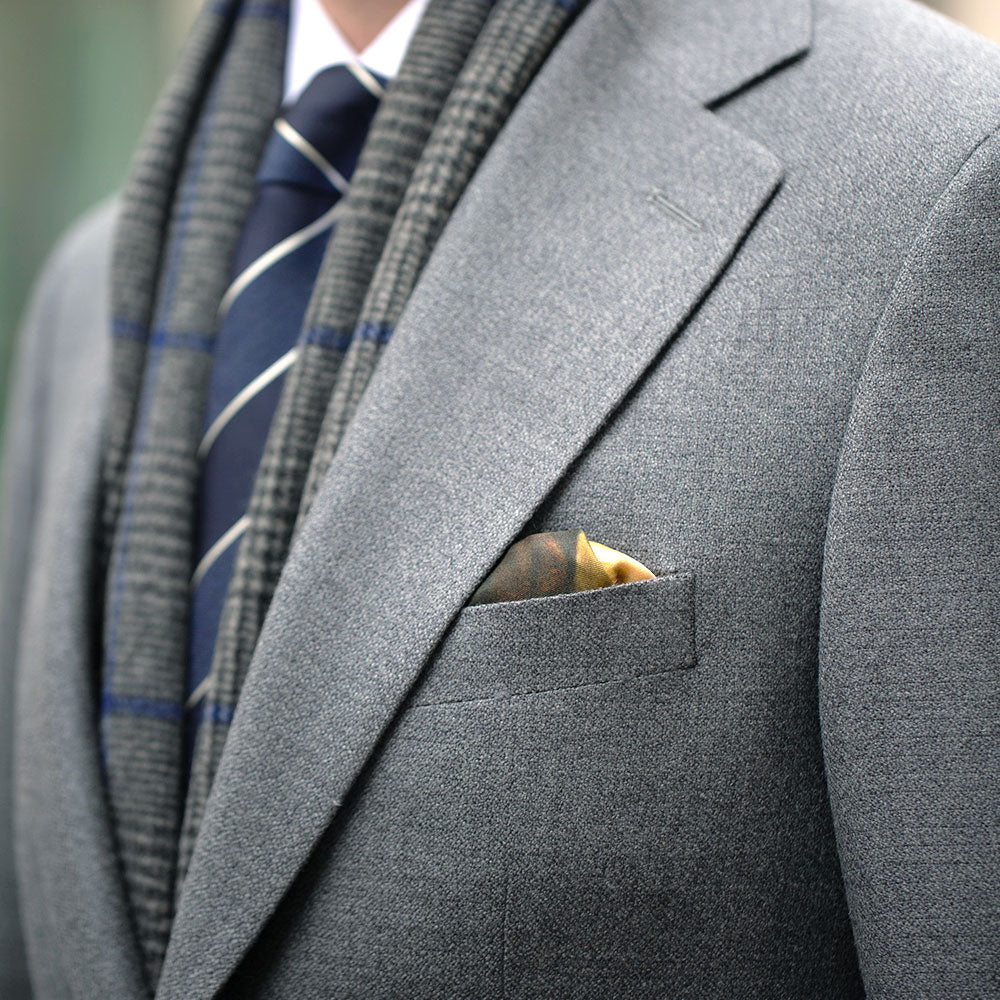
The tie and pocket square are the details that make that proposition complete. The suit provides the frame. The accessories make the argument. After three hundred and sixty years, the argument remains entirely sound.
Frequently Asked QuestionsFAQs About the History of the Men's Suit
When was the modern men's suit invented?
Most costume historians trace the modern suit to 1666, when King Charles II, under financial and political pressure, introduced a long coat, waistcoat, and breeches all in the same cloth at the English court. The principle of matching fabric across all pieces, which is the founding idea of the suit, dates to that moment of enforced economy.
Why does a suit jacket have lapels?
Lapels were originally the folded-back front of a coat that buttoned from chin to waist. As the coat evolved from a practical protective garment into a tailored one worn open, the fold became decorative. Lapels have served no structural purpose for well over a century. They remain because they are, by now, the thing that makes a jacket look like a jacket.
What did Beau Brummell wear?
Fine wool, clean linen, a dark coat with a pale shirt beneath it, and an exact fit with none of the effort showing. His contribution to men's dress was less a set of garments than a principle: that quiet precision is more impressive than visible effort. It is a principle that continues to hold.
What is a demob suit?
A demobilisation suit was the garment issued to British servicemen returning to civilian life after the second world war. Produced quickly and economically to clothe millions of men leaving military service, it became shorthand for the immediate postwar period, and for the particular look of a country resuming ordinary life in a hurry.
How did Italian tailoring change the modern suit?
Italian tailoring, from the 1970s onward, moved men's suits toward lighter construction and softer silhouettes. Giorgio Armani's removal of the heavy canvas interlining produced a jacket that felt fundamentally different, and demonstrated that structure was a choice rather than a requirement. The resulting lighter tradition has remained influential ever since.
What accessories work best with a suit?
A tie and pocket square are the traditional finishing details that make the effort of the suit worthwhile. Proportion is the principle: the tie should agree with the lapel width, and the pocket square should complement rather than repeat. These are the details that, as three and a half centuries of men's dress demonstrate, the men who dress well have always paid attention to. Explore silk and madder silk ties and handmade pocket squares from the Rampley collection.
To view the full collection click on the button below.